

On Preserving a Romantic and Creative Inner Life
advice for writers
WHERE I’M WRITING FROM
, Madonna’s Like a Prayer is circling my ears, the bass irritating my knockoff AirPods. I’m lying down in a black dress under the direct Spanish sun on an unstable hill in Parque del Oeste. To my right, I see the clear outline of mountains. Behind me, residential buildings with blue and orange awnings flap expensively as the wind rises.
Barefoot, my ear close to the earth, I finally feel like I’m coming back to myself. Magpies, always in pairs, trot after each other. Only after moving to Madrid did I learn that magpies mate for life. I’m beside two trees where one is more naked than the other. Spring burst quite abruptly and rather quickly, here in Madrid. This season, despite being fraught with traveling pollen and dull headaches, wraps me into a concentrated and peaceful state of observation. I get up and pull my blanket a few inches over, into the safety of partial shade. I sit back on my mat. I had either walked through morning dew or dog piss.
I peel my second tangerine. My thumb stabs at its center; the pressure feels violent but necessary. I suppose the act of peeling anything is always like that. You have to puncture the core first before any unraveling begins. My fingers burst through the skin of the fruit, and I let the juices stain my new picnic blanket. My iron is low, and I’m losing patches of hair, so I’m eating more tangerines and spending more time under the sun than usual.
And because my soul is so unlimited that it is no longer me, and because it is so beyond me—because I am always remote to myself, I am as unreachable to myself as a star is unreachable to me.
Clarice Lispector, The Passion According to G.H.
The first time I read Lan Samantha Chang’s essay “Writers, Protect Your Inner Life,” I was in my early twenties and deeply confused by her advice to writers and artists. She spoke about knowing the difference between a “writing life” and a “writing career.” At the time, I assumed the two were inseparable. How could one exist without the other?
Time eventually answered that question, reshaping my understanding of art, as well as my measures of success and happiness. Now, I have reached a point in my life where I am willing to sacrifice everything if it means preserving my relationship with writing.
Chang writes, “We must wall off our inner selves from the colonizing part that assesses, quantifies, judges….Hold onto that part of you that first compelled you to start writing. Hold onto that self through the vicissitudes of ‘career’. A writing life and a writing career are two separate things, and it’s crucial to keep the first. The single essential survival skill for anybody interested in creating art is to learn to defend this inner life from the world.”
Writers are mutable, fickle beings. How else do we defend our inner life from the same wretched world we must bare our hearts to? It becomes a breathless labor of turning our skin into bark in the hopes of being seen and perhaps, one day, understood. At the same time, we routinely break apart this bark, piece by piece, in order to touch the inner wood, in hopes it remains soft as it once was.
I hate to say it is subjective to each writer, but I do believe it begins with sitting down in the core of our being—spiritually and creatively. Before you place this existential fervor into practice, it is important to understand, to some degree, your private relationship with the things that bring you joy, comfort, or a sense of safety. They do not have to be grand or require much of your time. These things, as mundane as they are, can be ritualistic in nature.
Writers tend to drift far into dimly lit spaces for reasons sometimes unknown. We are daydreamers, anticipators, and lovers before we are creators. So we float away, either by way of our own egos or zealous ambition. Our feet hover just an inch above the soil beneath us. Rituals act as small reminders of how to come back to ourselves.
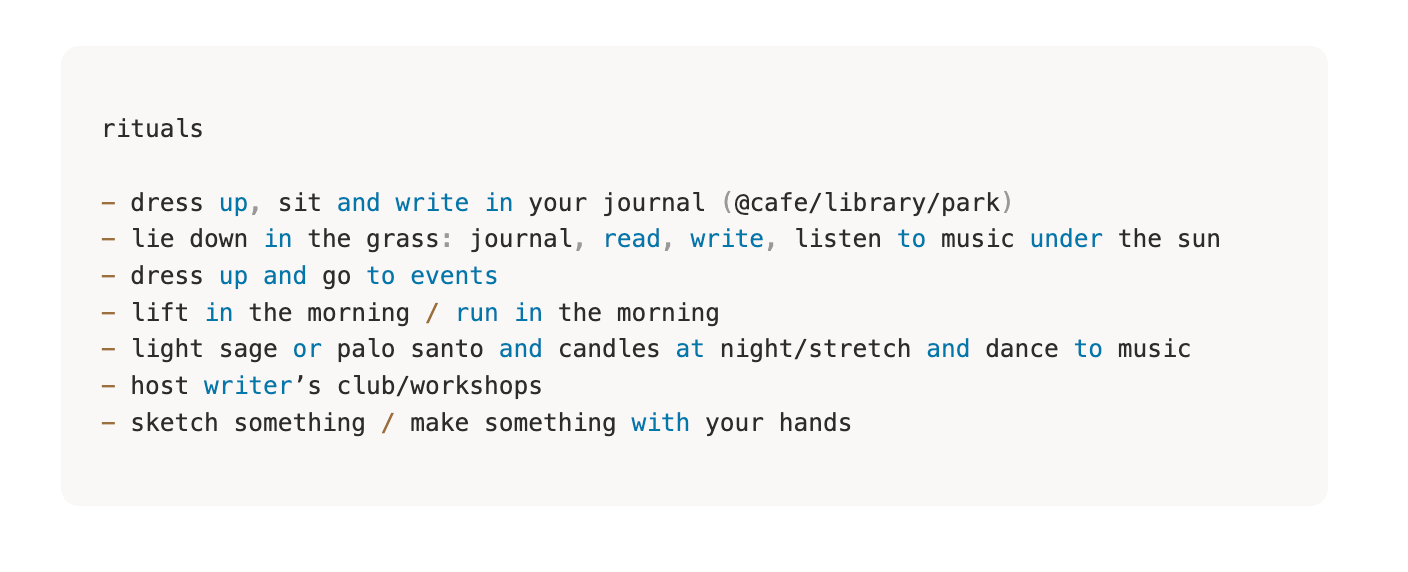
Another way to protect our inner life is by respecting its interior, despite how absurd it may seem. Lately, I’ve spent some time thinking about what it would look like if it were a physical place.
⏶⏷⏶
I imagine it being a house filled with disordered, romantic happenings.
Its floorboards, roof, doors, and tiles are constantly changing in shape and size. Inside, I walk through soft green carpets and scented lilac walls. Furniture decorated with wood darker than me: desks, coffee tables, dressers, cabinets. Strange doors lead to rooms congested with buildings from cities I have lived in. Terracotta tiles from the roof chip and fall during summer storms like baby teeth. Vines twist into railings on several balconies layered on top of each other. All of my mirrors clean themselves. On the sunniest of days, they bend and twist towards the light the way sunflowers do.
Where I sleep, sandalwood incense floods the air so thick that it snuffs out any candles that dare to compete for attention. Dried flowers remain frozen in time next to the bedside table. Across the room, there is a discreet vanity table covered with not-so-discreet trinkets. Emeralds, amethysts, citrine, opal, moonstone, jade, and lapis lazuli slip and weld themselves into silver rings, necklaces, or earrings. Gold materializes on special occasions like a wedding or a funeral. Crushed lavender buds spread like rose petals across the bed, dressed in ivory sheets.
A record player in the far right corner plays Prince on some days, Sufi music on other days. The bedroom has a balcony with french windows, partially covered by a patchwork cloth dyed in buttermilk yellow. Love letters and postcards stacked on top of my desk fold into planes and send themselves out every day at noon to their respective addresses. I watch my cat chase a trail of paper planes guided by the wind from the open windows. She loses patience, of course.
About a dozen past journals sit on top of each other on the floor next to my bed, collecting dust. A shelf next to my writing desk occasionally pushes books I do not finish onto the floor. It has a temperament, I find out. Vintage heels, jewel-toned leather bags, and bohemian fabrics hang in an open closet, color-coded.
Where I cook, lemons sit under the net of a thin crochet bag hanging from a hook by the heater. Fruit tarts, olive oil cakes, and jars of fig jam line the petite island. Chili oil made by a dear friend and hot sauces I have collected around the world threaten to burst through my upper cabinets. They want to be seen, too. Under the narrow floor of the kitchen balcony, a row of polite ants carries pieces of broken dark chocolate into a pea-sized crack between two clay tiles. Once a month, when I suddenly start craving chocolate, the ants anticipate a grand feast. They see me as some kind of generous deity, I suppose. In the sink, a melody of cups soak in used tea bags: mint, chamomile, earl grey, saffron, black tea.
This is a place of accumulated rememberings…surreal memories from the material world. The house is always in some kind of transit, physically as well as in its reflections. Though it is an architectural disaster, its absurdity provides a home for the many unknowns that coexist.
⏶⏷⏶
Though this inner life must provide a space to retreat into, it cannot be too legible.
The final part of protecting it is by avoiding familiarity. I’ve written about this before, but I believe the key to living a full life is surprise. To be surprised by others and the world, you must first learn to surprise yourself. That can only exist when you allow for uncertainty and remain rooted in the idea that you can never truly know yourself.
Nina Montagne’s brilliant video essay explores desire and the unfinished self, and she breaks apart a few philosophies and books that discuss the importance of preserving our privacy and our relationship with mystery. This act becomes exceedingly dire as artists negotiate their sense of self within a hyper-vigilant, metric-focused, surveilled society.
Who are you really when you are not actively being measured or observed: by your expectations, your pride, your rules, your principles, your relationships, your dreams?
How I protect my inner life is by never twisting my arm too deep inside that house, tracing the outlines of every precious thing and memory. I cannot search for absolute truths because the inner life was never meant to hold them. That is why the house shifts its floors or changes the colors of its doors. For me to write, and write well, I must surrender to change.
Rilke writes in Letters to a Young Poet, “...be patient toward all that is unsolved in your heart and try to love the questions themselves, like locked rooms and like books that are now written in a very foreign tongue. Do not now seek the answers, which cannot be given to you because you would not be able to live them. And the point is, to live everything. Live the questions now. Perhaps you will then gradually, without noticing it, live along some distant day into the answer.”
It can be tempting to want to know ourselves at every moment of discomfort or disruption. It is easy to cope by naming and prescribing meaning to every feeling, but over time, it becomes, as Nina puts it in her video, “a complete flattening of the self”. In order to grow as a human, you must become a stranger to yourself now and then. As lonely as it may be, there is beauty in that distance, in some remote part of ourselves we cannot yet extract with language.
The inner life flourishes under private obscurity. It is within that oblivion that writers reach to make meaning out of something that protests articulation. In that reaching lies potentiality, depth, and surprise—all of which are reasons to feel alive again and again.
I do not know if I write to change or if writing changes me, but I can say with hopeful certainty that I wish to continue living an inner life so romantic and so creative that it spills over into my outer life.
adored this!! such amazing work!
As usual, great post :)